
A startup usually notices stamps at the exact moment something urgent needs to go out – incorporation papers, internal approvals, signed contracts, packaging, or branded product presentation. That is why choosing the best stamp options for startups is less about buying a generic office tool and more about setting up the right system early. The right stamp saves time, keeps documents consistent, supports compliance, and helps a new business look established from day one.
Some startups need one official company stamp and nothing more. Others need a small set: a finance stamp for invoices, a signature stamp for internal processing, or a branded stamp for boxes, bags, product tags, and inserts. The best choice depends on what kind of startup you are building, how often the stamp will be used, and whether your priority is document control, speed, presentation, or all three.
What the best stamp options for startups actually depend on
The fastest mistake is ordering based on price alone. A cheap stamp that smudges, dries out too quickly, or produces weak impressions becomes a daily nuisance. For a startup moving fast, that friction adds up.
A better way to decide is to start with use case. If your team is stamping documents all day, you need speed and consistency. If the stamp is for occasional official paperwork, compactness may matter more than volume. If you are branding packaging or handmade goods, the stamp has to match your material surface and your visual standard.
There is also the question of format. Many startups in the UAE and across international markets need bilingual company details, often in English and Arabic. That affects layout, readability, and stamp size. A skilled stamp maker can help adjust spacing, text hierarchy, and border shape so the final impression stays clear instead of crowded.
Self-inking stamps are the practical default
For most office-based startups, a self-inking stamp is the safest first purchase. It is fast, clean, and designed for repeated use. The built-in ink pad keeps the process simple, which matters when multiple people in admin, finance, HR, or operations may use the same stamp throughout the day.
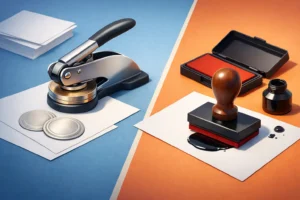
A self-inking company stamp works especially well for routine paperwork like invoices, payment approvals, received documents, internal records, and standard business forms. The impression stays consistent because the mechanism applies even pressure. That consistency helps a startup look organized even when the team is still building processes behind the scenes.
The trade-off is that self-inking stamps are not always the best fit for highly detailed artwork or luxury branding use. They are functional first. If your priority is office efficiency, that is exactly what you want. If your priority is a premium visual finish on packaging, another option may perform better.
Pre-inked stamps offer sharper detail
If your startup needs a cleaner, more refined impression, pre-inked stamps are worth serious attention. They usually deliver sharper detail than standard self-inking models, which makes them a strong choice for logos, signatures, and compact layouts with finer text.
This can be useful for founders who want one stamp to handle both official and presentation-related tasks. A pre-inked stamp often creates a smooth, crisp mark with less noise around the edges. For businesses that care about every printed touchpoint, that polished result matters.
The trade-off is usage volume. Pre-inked stamps perform beautifully, but if they are being used nonstop all day in a busy admin environment, some teams still prefer the mechanical durability and easy re-inking routine of self-inking units. It depends on whether your startup values finesse or heavy-duty repetition more.
Traditional rubber stamps still make sense in some cases
A standard rubber stamp with a separate ink pad may sound old-school, but it still has practical value. It is often a smart option when startups want flexibility with ink colors, stamp surfaces, or occasional use without investing in a higher-cost mechanism.
This format works well for warehouses, back-office processing, and situations where the stamp is not used constantly but needs to work on different materials. You can also switch ink types more easily, which can matter if you stamp kraft packaging, specialty papers, or nonstandard stock.
The downside is speed and cleanliness. Separate pads create more room for inconsistent impressions, over-inking, or messy handling. For a founder trying to streamline operations, that can become annoying fast. Still, for certain branding applications or low-frequency use, rubber stamps remain one of the most versatile choices.
Official company stamps are usually the first priority
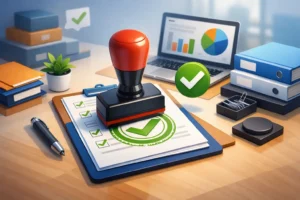
If your startup is newly formed, the official company stamp should usually come first. This is the stamp used for business documentation, approvals, forms, and administrative processing. It needs to be legible, correctly formatted, and durable enough for regular use.
A good company stamp is not just about the business name. It may include registration details, contact information, designation fields, or bilingual text, depending on business needs and local requirements. The layout should be planned carefully so it looks professional and stamps clearly in one press.
For most new companies, the best configuration is a self-inking or pre-inked company stamp with a compact but readable shape. Round, rectangular, and oval formats can all work, but the right one depends on how much information must fit inside. Cramming too much detail into a small stamp is one of the most common ordering mistakes.
Branding stamps matter earlier than many founders expect
A lot of startups treat branding stamps as something to buy later. In reality, they often become useful much earlier, especially for retail, food, gifting, handmade products, and event-based businesses. A custom branding stamp can upgrade plain packaging, reinforce brand identity, and create a more finished customer experience without requiring large print runs.
For product-led startups, this can be one of the most cost-effective tools in the business. You can stamp boxes, bags, tissue wraps, inserts, sleeves, and labels with your logo or message. That gives you flexibility when packaging volumes are still changing and printed packaging minimums do not make sense yet.
The right choice here depends heavily on the surface. Paper and cardboard are straightforward. Fabric, leather, soap, clay, chocolate, and food-safe branding each require a different approach and, in some cases, a different type of stamp entirely. This is where specialist guidance matters. A branding stamp that looks perfect on paper may fail completely on waxed packaging or textured material.
Embossers, wax seals, and specialty stamps for premium positioning
Some startups are not trying to look merely functional. They want to look premium from the start. That is where embossing stamps, wax seals, and other specialty stamp formats can add value.
An embosser creates a raised impression, which works well for certificates, premium stationery, folders, and formal brand presentation. It is subtle, durable, and professional. For consultants, law-related businesses, boutique firms, and luxury service brands, it sends a stronger signal than a standard inked stamp.
Wax seals serve a different purpose. They are less about daily operations and more about presentation, gifting, invitations, packaging, and ceremonial use. For creative brands, wedding businesses, or high-end product packaging, a wax seal can make a memorable impression. It is not an operational necessity for most startups, but for the right brand, it can be part of the customer experience.
Specialty stamps like heat stamps, soap stamps, clay stamps, and food branding stamps belong in a more niche category. If your startup sells physical crafted products, these may be central to your brand. If not, they are unnecessary. The point is not to buy every option. The point is to buy the one that matches your product and your growth stage.
How startups should choose the right stamp supplier
Even the best stamp type can disappoint if the supplier gets the layout, materials, or production quality wrong. Startups should look for a provider that understands both official business stamp requirements and custom branding applications. Those are not always the same skill set.
Fast turnaround matters, especially when company documents are waiting. Clear artwork support matters too, because many startups do not have print-ready files when they first order. A supplier that can guide sizing, recommend the right model, and help optimize the design saves time and avoids reorders.
If your business operates in bilingual environments or needs region-specific formatting, that experience is even more valuable. A specialist manufacturer like Digital Stamp Maker can help startups move from vague request to production-ready order quickly, which is often exactly what new businesses need.
The smartest startup approach
The best stamp options for startups are rarely about one perfect product. They are about matching the stamp to the job. For most businesses, that means starting with an official company stamp, then adding a branding or specialty stamp only when there is a clear operational or visual reason to do it.
Buy for the work you do now, not the version of the business you imagine two years from today. A well-made stamp should make your next approval, shipment, invoice, or package easier by the end of this week.