
A rushed stamp order usually creates two problems at once: the wrong impression on paper and a delay nobody planned for. This business stamp ordering guide is built for buyers who need to get it right the first time, whether you are ordering a company chop for daily office use, a bilingual approval stamp for finance, or a custom branding stamp for product packaging.
The best stamp order is not just about picking a shape and uploading a logo. It starts with knowing exactly how the stamp will be used, who will use it, what surface it will mark, and whether any formal company documents need to be matched. Once those details are clear, production moves faster, approvals are easier, and the finished impression performs the way it should.
What to decide before you request a quote
Most ordering mistakes happen before design even starts. A buyer asks for a company stamp, but the real need might be a self-inking office stamp for high-frequency paperwork, a pre-inked stamp for cleaner detail, or a rubber stamp for occasional use on specialty ink pads. These are not small differences. They affect impression quality, refill needs, speed, and long-term durability.
If the stamp is for internal business operations, start with the workflow. Ask how many times it will be used each day, whether multiple team members will handle it, and what information must appear in the layout. A stamp used at a front desk all day needs a different build than one kept in a legal drawer for occasional execution.
If the stamp is for branding, focus on the material being marked. Paper bags, cardboard boxes, wax, food-safe applications, leather, soap, clay, and fabric all require different production methods. A beautiful logo layout can still fail if the stamp type does not match the surface.
Business stamp ordering guide: choosing the right type
For most offices, self-inking stamps are the practical starting point. They are clean, fast, and reliable for repeated use. They work well for company names, paid stamps, received stamps, signature stamps, and standard administrative text. If your team needs speed at a desk, this is often the simplest choice.
Pre-inked stamps are a strong option when impression detail matters. They can produce a sharper, more refined mark, which is useful for logos, smaller text, and professional document presentation. The trade-off is that they are not always the best fit for rough handling or very heavy daily volume.
Traditional rubber stamps still have a place, especially when flexibility matters. If you need to switch ink colors, stamp on unusual materials, or use specialty inks, a rubber stamp with a separate pad is often the better tool. It requires a bit more manual handling, but it gives you more control.
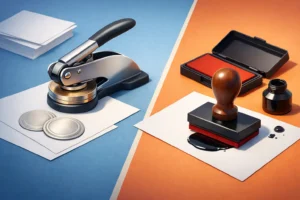
Embossers, wax seals, and specialty branding stamps serve very different purposes. An embosser adds a raised mark for premium document presentation. A wax seal creates ceremonial or luxury packaging value. Heat stamps, soap stamps, clay stamps, and food branding stamps are purpose-built tools where material compatibility matters far more than office convenience.
The details your artwork must include
A stamp layout has very little space to hide mistakes. That is why clear artwork preparation matters. If you are ordering a company stamp, confirm the exact legal or trading name, phone number, registration details if needed, and preferred language format before any proof is created.
Bilingual layouts need extra care. English and Arabic text must be accurate, balanced, and readable at stamp size. If one language is too small or compressed, the final impression loses clarity. In many UAE business settings, this is not just a design issue. It affects professionalism and usability.
Logos also need to be checked for stamp compatibility. Fine gradients, ultra-thin lines, tiny taglines, and highly intricate icons often need simplification to produce a strong impression. Good stamp design is not the same as brochure design. A capable maker will adjust the artwork so the printed mark stays crisp instead of muddy.
When documents are required and why it matters
Not every stamp order requires supporting documents, but many official company stamp requests do. For business buyers, especially first-time purchasers, this is where delays can start. The company name on the stamp should match the business records being used for the order. If there is a mismatch in spelling, language, or legal structure, production may need clarification before it can move forward.
That is not bureaucracy for the sake of it. It protects the buyer from receiving a stamp that cannot be used properly for invoices, forms, approvals, or internal controls. If your office needs a company stamp tied to trade license details or formal registration records, prepare those files in advance and send clear copies.
For repeat orders, keeping an approved layout on file makes the process much faster. That is especially helpful for procurement teams, finance departments, and multi-branch businesses that need consistent output across locations.
Business stamp ordering guide for faster approval
Speed matters, but rushed approval creates expensive rework. The fastest way to order is to send complete information in one message: stamp type, size, text, language, logo file, quantity, preferred ink color, and delivery timing. If the order is urgent, say that at the start, not after proofing has begun.
It also helps to nominate one approver. Too many internal reviewers often create conflicting instructions, especially on layout, Arabic text placement, or title formatting. One decision maker keeps the process clean and production on schedule.
When you receive a proof, check spelling, phone numbers, registration details, logo alignment, and size. Do not approve based on general appearance alone. A stamp can look fine at a glance and still contain a small error that becomes very costly once it is in daily use.
Size, shape, and impression quality
Bigger is not always better. Many buyers choose oversized stamps assuming they will look more official, but large layouts can become inefficient for routine documents. They take more space, require more pressure, and may create clutter on forms.
A compact rectangular or round format is usually best for standard company information. For approval marks such as paid, checked, received, or confidential, smaller functional sizes keep documents organized. For branding use, the best size depends on packaging dimensions and visual impact.
Impression quality also depends on the right balance of text and white space. Cramming in every possible detail usually weakens readability. If the stamp must include multiple lines, a skilled layout adjustment can preserve clarity without losing necessary information.
What buyers should ask about production and delivery
A reliable stamp supplier should be able to explain turnaround time, proofing steps, refill options, replacement pads, and expected performance. For office buyers, practical support matters as much as design. If the stamp will be used daily, ask about longevity and consumables. If it is for premium branding, ask how the material and engraving method affect the final mark.
Delivery timing should also be realistic. Same-day or urgent service can be valuable, but only if artwork and documents are complete. Fast production works best when the buyer provides clean inputs and approves promptly.
If you are ordering for multiple departments, ask whether the order can be standardized. Grouping company stamps, name stamps, signages, badges, and related items into one coordinated request often saves time and reduces inconsistencies.
Common ordering mistakes that slow everything down
The most common mistake is sending low-quality artwork and expecting a perfect result. The second is not confirming the exact company name. The third is choosing a stamp style based on price alone instead of use case.
Another frequent issue is ignoring the stamping surface. Office stamps and product-branding stamps are not interchangeable. A stamp that works perfectly on paper may fail on kraft bags, boxes, wax, leather, or soap.
Finally, buyers often underestimate the value of design support. A good supplier does more than manufacture. They help refine the layout, catch technical issues early, and recommend a stamp format that performs well in real use.
For businesses and creators alike, a stamp is a working tool. It carries authority, speeds up operations, and shapes how your brand appears in the real world. Order with clear information, choose the format that matches the job, and give the proof the attention it deserves. That is how a simple stamp order becomes one less thing to worry about.