
A contract can be perfectly written and still feel unfinished when the execution details are weak. For many businesses, a custom seal for contracts adds the final layer of formality, identity, and control. It signals that the document has been reviewed, approved, and issued with intention – not just printed and signed in a hurry.
For legal teams, finance departments, office managers, and founders, that distinction matters. A seal does not replace legal drafting or authorized signatures, but it does strengthen presentation and internal consistency. It also reduces the mess that comes from using generic stamps, unclear markings, or improvised approval methods across important paperwork.
Why a custom seal for contracts still matters
Contracts are practical documents, but they are also trust documents. When a supplier agreement, board resolution, tenancy document, or internal approval letter carries a clear company seal, it looks controlled and official. That matters in client-facing transactions, in cross-border paperwork, and in internal processes where document authenticity needs to be obvious at a glance.
There is also a branding layer. A proper seal reinforces the company name, registration details, or bilingual identity in a way that handwritten markings cannot. In industries where presentation influences confidence – real estate, consulting, trading, construction, professional services, and procurement – details like this help create a stronger impression.
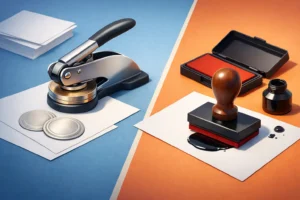
That said, not every contract needs the same type of seal. Some businesses need a stamp for fast daily use. Others want an embosser for premium execution copies. Some want a wax seal for ceremonial or presentation documents rather than operational paperwork. The right choice depends on volume, document type, and how formal the result needs to look.
What type of custom seal for contracts should you choose?
The first decision is functional. Are you sealing contracts for speed, appearance, or both?
Self-inking seals for high-volume office use
If your team handles contracts every day, a self-inking stamp is often the most efficient option. It delivers fast, repeatable impressions with less setup and less mess. This works well for admin teams, procurement staff, logistics offices, and companies processing vendor agreements, acknowledgment letters, and internal approvals in batches.
The main advantage is consistency. A well-made self-inking seal gives a clean impression in seconds and holds up under repeated use. If your contracts move through several desks in one day, this is usually the practical choice.
Pre-inked seals for sharper detail
Pre-inked seals are a strong option when you want finer detail, cleaner lines, and a more polished result. They suit companies that want a crisp seal impression for execution copies, client documents, and lower-volume but more presentation-sensitive paperwork.
They are not always the best fit for rough, nonstop office handling, but they perform very well when appearance matters. If your artwork includes finer text, a logo, or bilingual content, pre-inked often produces a more refined impression.
Embossing seals for premium formal documents
An embossing seal creates a raised impression in the paper rather than an ink mark. This style is often chosen for premium contract packs, official certificates, legal folders, board documents, and presentation copies where the goal is authority and permanence.
An embosser looks impressive, but it has trade-offs. It is slower than a stamp, works best on suitable paper stocks, and may be less practical for high-volume processing. For many companies, the best setup is not one tool instead of another, but a combination – a stamp for day-to-day use and an embosser for formal sets.
Wax seals for ceremonial or brand-led use
Wax seals are rarely the standard choice for operational contracts, but they do have a place. Luxury brands, event businesses, law firms handling presentation documents, and creative studios sometimes use wax seals for contract folders, invitation agreements, partnership packs, or commemorative signings.
They create a strong visual statement, but speed is not the goal. If the contract needs to move through practical office workflows, wax is usually decorative rather than functional.
What should appear on a contract seal?
A good contract seal is clear before it is decorative. In most business cases, the design should include the registered company name and any required supporting details such as city, license number, or department wording if relevant to internal use.
For many companies, bilingual customization is worth considering. If you regularly issue documents to both English- and Arabic-reading parties, a bilingual seal can reduce confusion and make the document set feel more aligned with your market. The layout needs careful planning, though. Trying to fit too much text into a small seal often weakens readability.
A logo may be useful, but only if the shape and line weight allow it to reproduce clearly. Fine lines, complex icons, and tiny taglines often look good on screen and poor on paper. The better approach is to simplify the artwork so the seal stays legible after hundreds of impressions.
Design choices that affect the final result
Many buyers focus on the wording first and the build second. In practice, both matter equally.
Size changes everything. A seal that is too small can become hard to read, especially if it includes legal names or multilingual text. A seal that is too large can dominate the page and look clumsy on standard contract margins. For most contract use, balance matters more than maximum presence.
Shape also affects usability. Round seals often feel formal and traditional. Rectangular seals are easier for denser text. Oval and custom shapes can work well, but only when the layout supports them. The most professional result usually comes from designing around the content rather than forcing the content into a fashionable shape.
Ink color is another decision with practical consequences. Blue and black remain the most common for contracts because they read clearly and suit formal business documents. Red can be useful in approval workflows or internal control settings, but it can feel too aggressive for execution copies. If your contracts are scanned, test readability before standardizing a color.
Common mistakes when ordering a seal for contracts
The most common mistake is treating all seals as interchangeable. They are not. A seal for packaging, invitations, or product branding is built for a different purpose than a seal used on legal or commercial paperwork.
Another problem is overcrowding the design. Buyers sometimes request a company name, logo, registration number, department title, address, phone number, and slogan on one small seal. The result is usually weak. Contract seals work best when the essential information is prioritized and the impression stays clean.
There is also the issue of approval. If the design is based on outdated company details, wrong spelling, or an old logo file, the seal becomes a daily annoyance instead of a useful tool. Before production, the artwork should be checked against current business records and actual contract use.
Finally, some companies choose the cheapest build and then expect long-term heavy-duty performance. For occasional use, that may be fine. For finance teams, admin departments, and legal offices stamping documents every week, durability should be part of the buying decision from the start.
How to order the right seal without delays
A smooth order usually starts with three things: your exact company wording, your preferred seal type, and a clear idea of how the seal will be used. Once those are defined, production becomes faster and design revisions stay minimal.
If you already have branding files, send them in the best quality available. If not, a supplier with design support can still help organize the text and format the layout properly. This matters more than many first-time buyers expect. A professionally adjusted seal file often produces a much stronger impression than a direct copy from a low-resolution logo image.
It also helps to mention whether the seal is for internal contracts, client-facing agreements, legal execution copies, or premium presentation sets. The more specific the use case, the easier it is to recommend the right tool. Digital Stamp Maker handles this kind of custom production with the practical support businesses need – especially when speed, clear proofs, and repeatable quality are part of the job.
When one seal is not enough
As companies grow, one generic stamp often stops being enough. You may need a formal company seal for signed contracts, a department stamp for internal processing, and an embosser for presentation copies. That is not overcomplicating the system. It is building a document workflow that matches how your business actually operates.
The best contract seal is the one that fits your process, not just your logo. If the tool is clear, durable, and built for the way your team works, every signed document feels more deliberate from the first impression to the final filing.