A missing stamp usually becomes a problem at the worst possible time – when invoices need approval, documents are moving for signature, or a package is ready to leave with your brand on it. That is why company stamps are still a practical business essential across offices, retail counters, warehouses, studios, and production spaces. The right stamp saves time, keeps paperwork consistent, and gives your business a more professional finish every day.
For some businesses, a company stamp is strictly operational. It appears on contracts, internal approvals, delivery notes, invoices, and accounting documents. For others, it is part of brand presentation, used on packaging, cards, labels, bags, or product surfaces. Both uses matter, but they call for different stamp types, different materials, and a different level of customization.
What company stamps actually do
At a basic level, company stamps create speed and consistency. Instead of rewriting company details, approval language, payment terms, or department markings, your team applies the same clear impression every time. In a busy office, that reduces small errors and keeps documents moving.
They also add authority. A properly made stamp with the correct company name, designation, and layout helps formal paperwork look complete and organized. For finance teams and administrators, that is not just about appearance. It supports cleaner internal processes and faster handling.
There is also a branding function that many buyers underestimate. A custom stamp used on packaging or inserts can create a premium touch without the cost of large-volume printing. That matters for boutiques, bakeries, soap brands, coffee businesses, leather makers, and event suppliers that want flexibility in short runs or seasonal packaging.
Types of company stamps and when each one fits
Not every stamp is built for the same job. Choosing the wrong format usually leads to smudging, weak impressions, or a tool that slows people down instead of helping them.
Self-inking company stamps
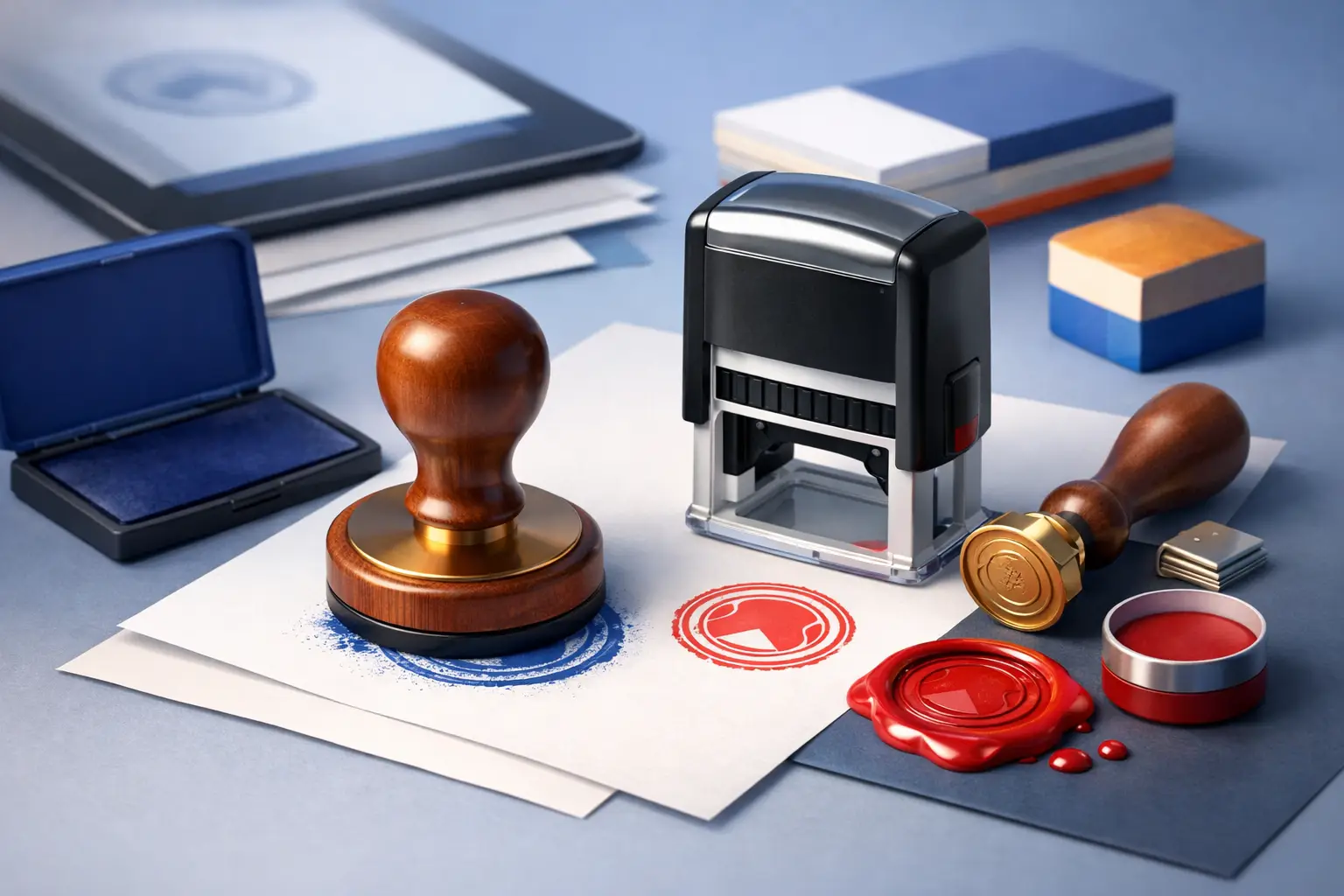
Self-inking stamps are the standard choice for office use because they are fast, clean, and easy to repeat. The ink pad is built into the body, so staff can stamp documents quickly without using a separate pad. If your team processes invoices, delivery notes, approvals, or routine paperwork every day, this is often the most efficient option.
They work best when you need repeated impressions with consistent alignment. The trade-off is that they are designed mainly for paper and standard office applications, not textured packaging or unusual surfaces.
Rubber stamps
Traditional rubber stamps remain useful because they are flexible. You can pair them with different ink colors or specialty inks depending on the surface. That makes them a good fit when the same artwork may be used on paper, card, kraft packaging, or other materials.
They require a separate ink pad, so they are slightly slower in high-volume office settings. But for creative businesses and custom branding work, that extra flexibility is often worth it.
Pre-inked stamps
Pre-inked stamps produce a sharp, detailed impression and are a strong option when fine text or a polished finish matters. They are often chosen for signatures, compact company details, or stamp designs where clarity is critical.
The advantage is precision. The limitation is that they are not always the best match for rough handling or very heavy daily stamping compared with sturdy self-inking units built for repetitive office use.
Embossing seals and specialty stamps
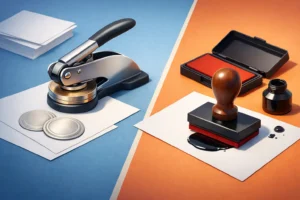
Some businesses need a raised impression rather than ink. Embossing seals can add formality to certificates, legal papers, official folders, and premium stationery. Specialty stamps such as wax seals, heat stamps, food branding stamps, soap stamps, or clay stamps serve a very different purpose – they turn a simple product into a branded one.
These are not interchangeable with standard office company stamps. They are purpose-built tools, and performance depends heavily on the material being stamped, the depth of engraving, and the pressure or heat involved.
What to include on a company stamp
A company stamp should be clear before it tries to be decorative. In most business cases, the essential details are the company name and any required supporting information such as license number, department name, phone number, location, or an approval label like PAID, RECEIVED, APPROVED, or ORIGINAL.
Too much text creates a crowded impression, especially on smaller stamp sizes. If your goal is document processing, prioritize readability. If your goal is packaging or product branding, a logo-led design may make more sense than a text-heavy one.
For UAE businesses, bilingual layouts are often the right choice. English and Arabic company stamps can support local business use while keeping communication clear across departments, customers, and official paperwork. The design has to be balanced carefully so neither language becomes too small to read.
How to choose the right company stamps for your business
The best choice depends on where the stamp will be used, how often it will be used, and what kind of impression you need it to leave.
If you are buying for administration or finance, start with function. Ask how many documents are stamped per day, who will use the stamp, and whether speed matters more than design detail. For frequent use, self-inking is usually the safest answer.
If you are buying for a product-based brand, think about surface and presentation. Paper bags, cardboard boxes, tissue, tags, soap, chocolate, leather, and wax all behave differently. A stamp that looks excellent on smooth paper may fail completely on coated packaging or textured stock. That is where proper material guidance matters.
If your company has urgent timelines, durability also matters. Cheap stamp bodies wear out, alignment weakens, and impressions become inconsistent. A well-made stamp should hold up under regular use and produce a dependable result from the first order through repeat jobs.
Why design support makes a real difference
Many stamp problems begin before production. The artwork may be too detailed, the text may be too small, the shape may not fit the content, or the chosen stamp type may not suit the intended use. That leads to remakes, wasted time, and poor impressions.
Good design support prevents that. A proper layout considers spacing, font weight, border thickness, logo simplification, and actual stamp size. It also helps first-time buyers who know what information they need but are not sure how it should be arranged.
This is especially important for businesses ordering official-use stamps and branded stamps at the same time. The technical requirements are different. One must communicate clearly and consistently in daily operations. The other must look premium on products or packaging. Treating them as the same job usually produces a weaker result on both sides.
Speed matters, but so does getting it right
Many stamp orders are urgent. A new company has just opened. A replacement stamp is needed immediately. A team has a filing deadline. An event brand needs packaging finished today. Fast production matters in all of these situations, but speed only helps if the stamp arrives ready to use and made correctly.
That is why experienced buyers look for a supplier that can handle both the technical side and the turnaround. Clear proofing, practical recommendations, quality materials, and reliable production matter just as much as same-day service. In a market like Dubai and the wider UAE, where business timelines move quickly, responsiveness is part of the product.
Digital Stamp Maker works in that space every day, producing company stamps for formal office use as well as custom impression tools for product branding, packaging, and specialty applications. The value is not just in making a stamp fast. It is in making the right stamp fast.
Common buying mistakes to avoid
One common mistake is ordering a stamp based only on price. Lower-cost options can work for light use, but heavy office demand often exposes weak materials quickly. Another is choosing a stamp size without checking how much information needs to fit inside it. Small stamps with long company names almost always lose readability.
A third mistake is ignoring refill and replacement needs. If a stamp is used daily, ink quality and future re-inking should be considered from the start. For specialty branding stamps, buyers also sometimes assume one tool will work across multiple product surfaces. Sometimes it can, but often each material needs its own approach.
The best results come from a simple buying mindset: define the use case first, then match the stamp type to that job.
A good company stamp should do more than leave a mark. It should make work faster, paperwork cleaner, and your business presentation more professional every time it touches the page or the product.